州
原页面:State
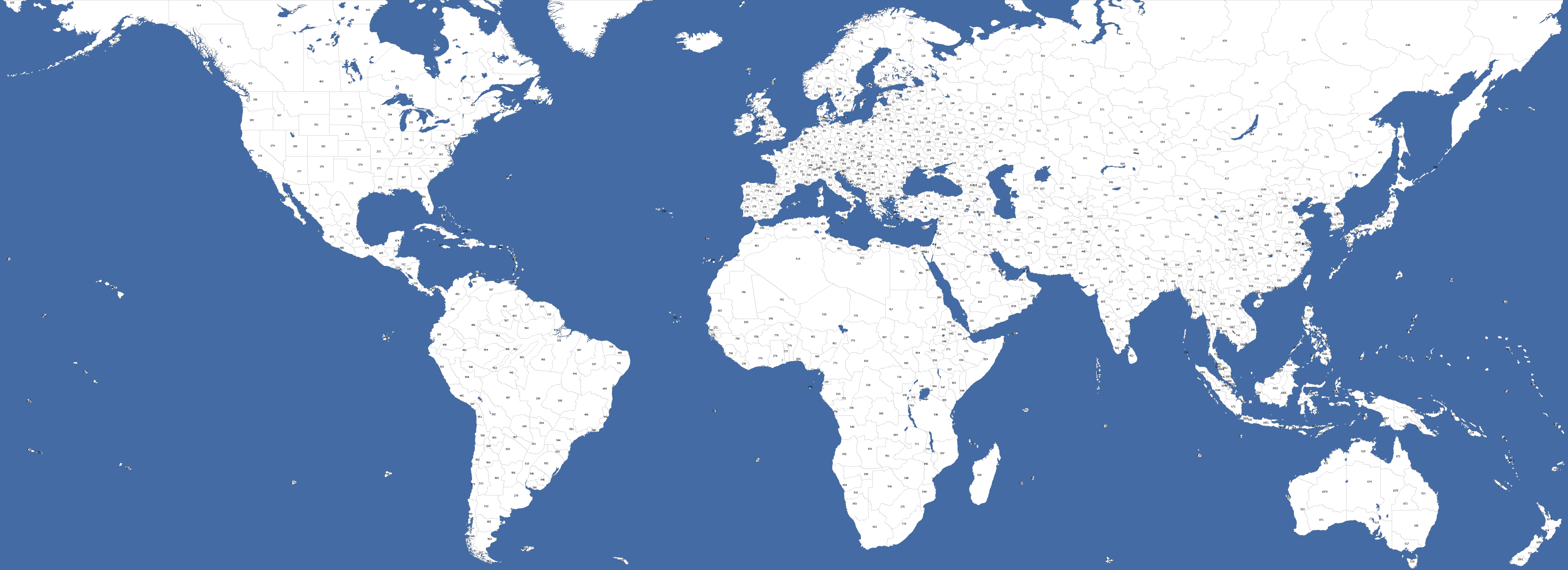
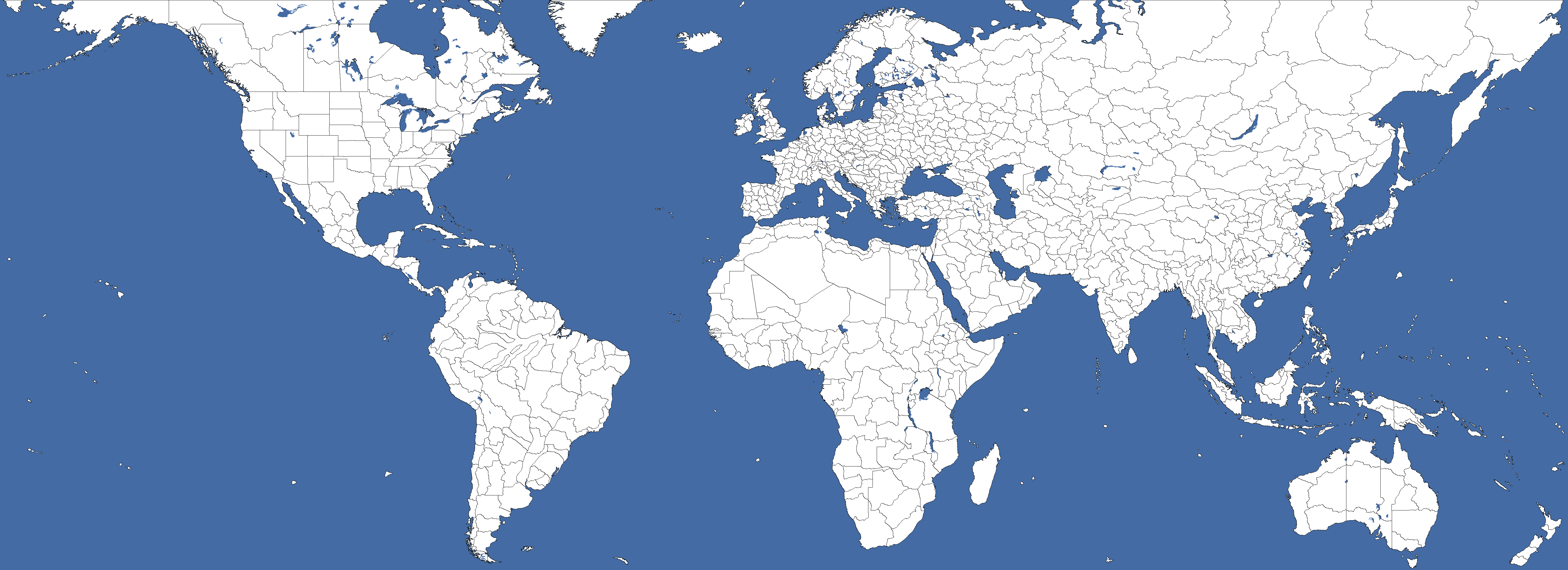
The state is the primary geographic unit of Hearts of Iron 4. A state consists of a set of 省份. In turn, 战略地区 and the territory of 国家 consist of a set of states.
外交
- 主条目:外交
Ownership over territory is determined at the state level. Control over both the resources and state-wide construction of a state is determined by the plurality controller of a state, meaning the country that controls the most victory points. Each province in a state is worth 0.1[1] victory points. Some provinces (usually cities) have additional victory points.
These are all named and marked with small squares (1 to 9 VPs), pentagons (10 to 15 VPs), circles (20 to 40 VPs), or stars (capitals with 1 to 50 VPs) on the map and their additional victory points are displayed in the tooltip when hovering over them. Resistance is computed at the state level.
Cores
States can be either core states or colony states. Cores are considered an integral part of the country, and the inhabitants are fully available for military service. Nations get a -98% penalty to manpower in colony states, and have half as many building slots available as in a core state.
Nations may justify war goals against foreign-owned core states in half the time and for half the political power as on other states. Only victory points in core states count when determining if a country will capitulate. When a nation controls a non-core state, that state will generate 抵抗度.
Unlike other Paradox games, there is normally no way for countries to gain cores. You can lose cores if you release/return territory of a country.
Some country-specific events and national focuses, like the Anschluss event for  德国 or decisions for
 墨西哥 for central America, will grant cores. As of the 抵抗运动 expansion, there is an exception to this rule, with
 无政府主义西班牙 able to core any state with enough compliance with the Global Defense Council focus.
建造
- 主条目:建造
Construction can be divided into three categories: state buildings, shared buildings and province buildings.
州级建筑
State buildings are state-wide and every state can reach the same maximum level for each building.
Infrastructure, airbases, anti-air and radar stations belong to this category.
Shared buildings are also state-wide, but the amount that can be built is limited to the number of free slots. Once all slots are occupied, no more shared buildings can be built.
Factories, dockyards, synthetic refineries, fuel silos, rocket sites, and nuclear reactors belong to this category
省级建筑
Province buildings are built per-province, their maximum levels depend on the type of building.
Naval bases, forts and supply hubs belong to this category.
资源
Resources for production are generated at the state level. The majority controller will have a certain amount of the resources of a state added to their resource pool depending on their occupation policy.
人口
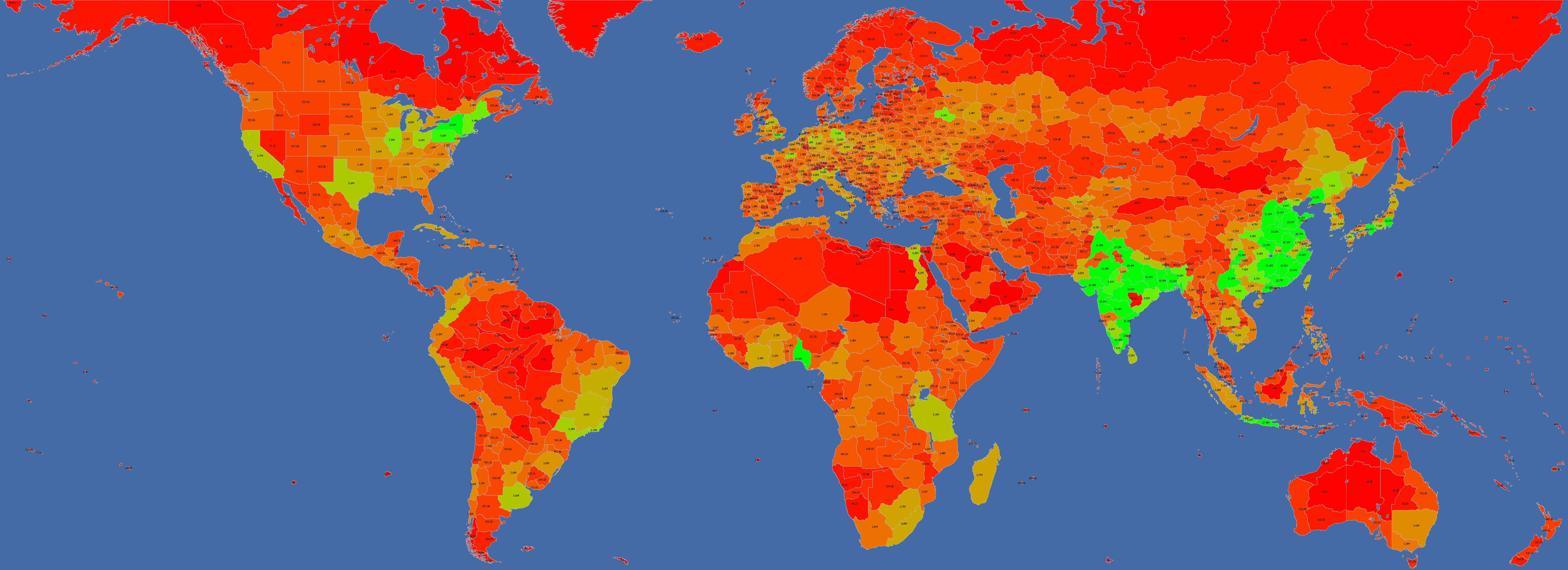
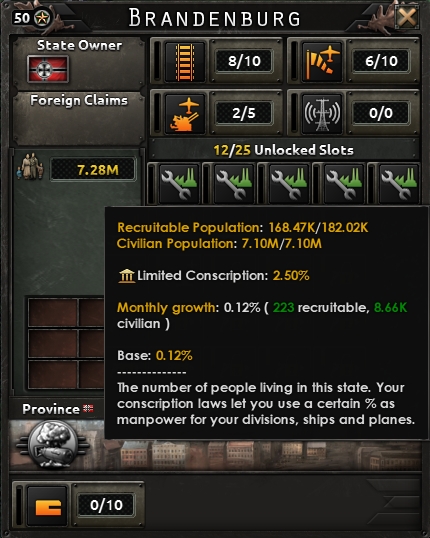
The population in a state is tracked by five numbers.
The total population is the population the state starts with; it is shown on the state's info panel. Monthly population growth is based on it and the total never declines. The game's duration usually spans less than a generation, so all inhabitants that could enter military service are already born at the start of the game.
The 可招募人口 is available for the controlling country to use in military service. Recruitable population gets reduced as 人力 is used in the military, not just after taking casualties.
The recruitable population cap is a fraction of the total population that limits the recruitable population. For how the fraction is calculated, see 可招募人口.
The civilian population is the portion of the population that is not available for military service.
The civilian population cap is a fraction of the total population that limits the civilian population. It is the total population minus the recruitable population cap.
Changes in the effective recruitable population ratio can cause one of the two population counts to overflow. In this case population is transferred to the other population type. For example, if a country raises its recruitment law, the civilian population cap will go down over time (according to the mobilization speed), which causes some civilian population to be transferred to recruitable population. Conversely, if a state is captured by a country that does not have a core on it, the recruitable ratio will be massively reduced and might cause recruitable population to transfer back to civilian population.
增长
The state's total population grows by +0.125% at the start of every month. The increase in population is distributed between recruitable and the civilian population by the recruitable ratio. Both increases are always at least one person respectively.
类别
The state category usually decides on the amount of shared building slots available to use. The category for any state is decided at the game's start and it isn't generally possible to change, however certain countries have content allowing them to upgrade the state category of certain states.[a] The state categories also determine the colour of the state in the states map mode. These state categories exist in the base game:
| 名称 | Amount of slots | Color in the states map mode |
|---|---|---|
| 荒地 | 0 | |
| 飞地 | 0 | |
| 微型岛屿 | 0 | |
| 牧区 | 1 | |
| 小岛 | 1 | |
| 乡村区 | 2 | |
| 发达乡村区 | 4 | |
| 稀疏城市区 | 5 | |
| 城市区 | 6 | |
| 密集城市区 | 8 | |
| 大都市区 | 10 | |
| 特大都市区 | 12 |
州修正
These are modifiers that states can have that can affect them in major ways. They are typically country specific.
| 修正 | 效果 | 国家 |
|---|---|---|
| Krasnaya Gorka Battery (Soviet Union) |
|
 苏联 |
| Seraya Loshad Battery (Soviet Union) |
|
苏联
|
| Armored Battery 35 (Soviet Union) |
|
苏联
|
| Capital of the Tsars |
|
苏联
|
| International City |
|
 波兰 |
| International City |
|
波兰
|
| International City |
|
波兰
|
| International City |
|
波兰
|
| Unity Propaganda |
|
波兰
|
| Military Appeasement |
|
波兰
|
| Military Plans (Poland) |
|
波兰
|
| Anti-Russian Plans (Poland) |
|
|
| Anti-German Plans (Poland) |
|
|
| Autonomous State |
|
 西班牙 |
| Unplanned Offensive |
|
西班牙
|
 Widespread Bulgarian Sentiment |
|
|
| Widespread Bulgarian Sentiment
|
|
|
| Skirmishes Against the IMRO |
|
 保加利亚 |
| Pre-Arranged Bulgarian Territorial Expansion |
|
|
 Kemalist Loyalties |
|
 土耳其 |
 凯末尔主义阴谋者 |
|
土耳其
|
 Devout Traditionalists |
|
土耳其
|
| Traditionalists Placated
|
|
土耳其
|
 传统主义者反对派 |
|
土耳其
|
 传统主义者叛乱宣传 |
|
土耳其
|
 传统主义者暴动 |
|
土耳其
|
 Separatist Fatigue |
|
土耳其
|
 库尔德人骚动 |
|
土耳其
|
 库尔德分离主义 |
|
土耳其
|
 库尔德人叛乱 |
|
土耳其
|
 Conscription Exemptions Granted |
|
土耳其
|
 图兰主义同化 |
|
|
 希腊王国

 Turan
占领
- 主条目:占领
The effects of occupation, including resistance, are computed at the state level.
注释与参考文献
^ a: Some examples of this mechanic include:
 Develop [Root.Capital.GetName] for countries in the Horn of Africa.
- State Owned Industry for
 埃塞俄比亚.
 The Holy Lands for
 意大利.
 Jäniskoski Power Plant for
 芬兰.
 Swedish决议"Promote Urbanization"
| 政治 | 意识形态 • 阵营 • 国策 • 理念 • 政府 • 傀儡国 • 流亡政府 • 外交 • 世界紧张度 • 内战 • 占领 • 力量均势 |
| 生产 | 贸易 • 生产 • 建造 • 装备 • 燃料 • 军工组织 • 国际市场 |
| 科研与科技 | 科研 • 步兵科技 • 支援连科技 • 装甲科技(也包括 未拥有绝不后退)• 火炮科技 • 陆军学说 • 特种部队学说 • 海军科技(也包括 未拥有全民持枪)• 海军支援科技 • 海军学说 • 空军科技(也包括 未拥有以血盟誓)• 空军学说 • Engineering科技 • Industry科技 • 特殊项目 • 科学家 |
| 军事与战争 | 战争 • 和平会议 • 陆军单位 • 陆战 • 师编制设计 • 坦克设计 • 陆军编制器 • 集团军 • 指挥官 • 作战计划 • 战斗战术 • 舰船 • 舰船设计(伦敦海军条约)• 海战 • 飞机设计 • 空战 • 经验 • 军官团 • 损耗与事故 • 后勤 • 人力 • 核弹 • 突袭 |
| 间谍活动 | 情报 • 情报机构 • 特工 • 任务 • 行动 |
| 地图 | 地图 • 省份 • 地形 • 天气 • 州 |
| 事件与决议 | 事件 • 决议 |